Tuesday, May 21, 2019

Villa Pasquale. A Rococo Masterpiece.


Whilst taking some pictures of the lattice ceiling by Bibiena in Chiesa di S.Maria Assunta, I was told there was an even more impressive piece of architecture by Bibiena in a little village not far from Sabbioneta near Mantua.


Villa Pasquale, Sabbioneta, MN

Villa Pasquale, Sabbioneta, MN


Behind the austere brick facade of the unfinished church in Villa Pasquali lies one of those little wonders that one comes across all the time in Italy. On entering into the building, you are stuck by the wonderful Rococò interior.


Villa Pasquale, Sabbioneta, MN

Villa, Pasquale, Sabbioneta, MN
Don Giovanni Battista the local priest hired one of the greatest Architects of the day to construct a Baroque masterpiece in this tiny hamlet.

Villa Pasquale, Sabbioneta, MN

Villa Pasquale, Sabbioneta, MN

Villa Pasquale, Sabbioneta, MN

Villa Pasquale, Sabbioneta, MN

Antonio Bibiena was famous for his theatres and here we immediately enter into the theatrical play of light and shadow. Here we have four double layer cupolas with a brickwork lattice partially hiding the frescoed outer cupola behind. Cleverly placed windows mostly hidden from view illuminate the cavity.


Villa Pasquale, Sabbioneta, MN

Villa Pasquale, Sabbioneta, MN

Villa Pasquale, Sabbioneta, MN

Villa Pasquale, Sabbioneta, MN

The purpose of what is called the “celestial prospective” is to give a worshiper a sensation of glimpsing Paradise with its Saints and Angels floating behind the lattice inner cupola.  


Work started in 1764 and the local population helped with the construction. Things did not go smoothly, the main cupola collapsed at a certain point during the works. Work resumed, and the church was finished in 1784. Lack of money meant that one of the two bell towers was not constructed and the brickwork was left bare.
Villa Pasquale, Sabbioneta, MN

Villa Pasquale, Sabbioneta,MN

Villa Pasquale, Sabbioneta, MN


On a rainy Sunday afternoon I was able to spend an interesting afternoon photographing this little architectural wonder.

Friday, March 22, 2019

Exploring the Land of the Gonzaga's


I have been exploring the obscure corners of the province of Mantua of late. I came across these three places on a recent exploration. 


The Oratorio dei Campi Bonelli It is one of the best-preserved churches dating from the Middle Ages in the area around Mantua. It is characteristic for its isolated rural location. In fact, one arrives after driving down a dusty farm road. 


Oratorio dei Campi Bonelli, MN

Oratorio dei campi Bonelli, MN

Oratorio dei Campi Bonelli, MN
The oratory, entirely in brick, was built in the eleventh century and has in the presbytery a cycle of frescoes from the fourteenth century.


Oratorio dei Campi Bonelli,MN

Oratorio dei Campi Bonelli

Oratorio dei Campi Bonelli, MN

Oratorio dei campi Bonelli,MN

Oratorio dei Campi Bonelli, MN
From the outside the plain brick building does not promise much, but the frescoes inside are rather lovely. They have been nicely restored. 

Oratorio dei Campi Bonelli,MN

Oratorio dei Campi Bonelli, MN

Oratorio dei Campi Bonelli, MN

Oratorio dei Campi Bonelli, MN

Oratorio dei Campi Bonelli, MN


A local lady left money in her will to pay for the restoration of this splendid little church.


Not far from the oratorio is an another little chapel, a short distance from Redonesco. The “Romitorio” of San Pietro, dates from the same period


Romitorio di San Pietro, MN

Romitorio di San Pietro, MN

Romitorio di San Pietro, MN


The existence of the church called the Romitorio di San Pietro is already documented at the beginning of the thirteenth century. Placed in a solitary and silent place, surrounded by a small river, where in ancient times stood a dense thicket, we find this building that dates back to around 1000.
Romitorio di San Pietro, MN

Romitorio di San Pietro, MN

Romitorio di San Pietro, MN
It was the domain of hermits, who led a contemplative life there.

The only aisle of this church is remarkable for its pure Romanesque form, without any columns or capitals. On the inside walls we can see frescoes dating from the fifteenth century.
Romitorio di san Pietro, MN

Oratorio di San Pietro, MN
Over time the church has been used, especially in times of neglect, as a place of refuge and shelter by troops, wayfarers or other people who needed a place to sleep and shelter.

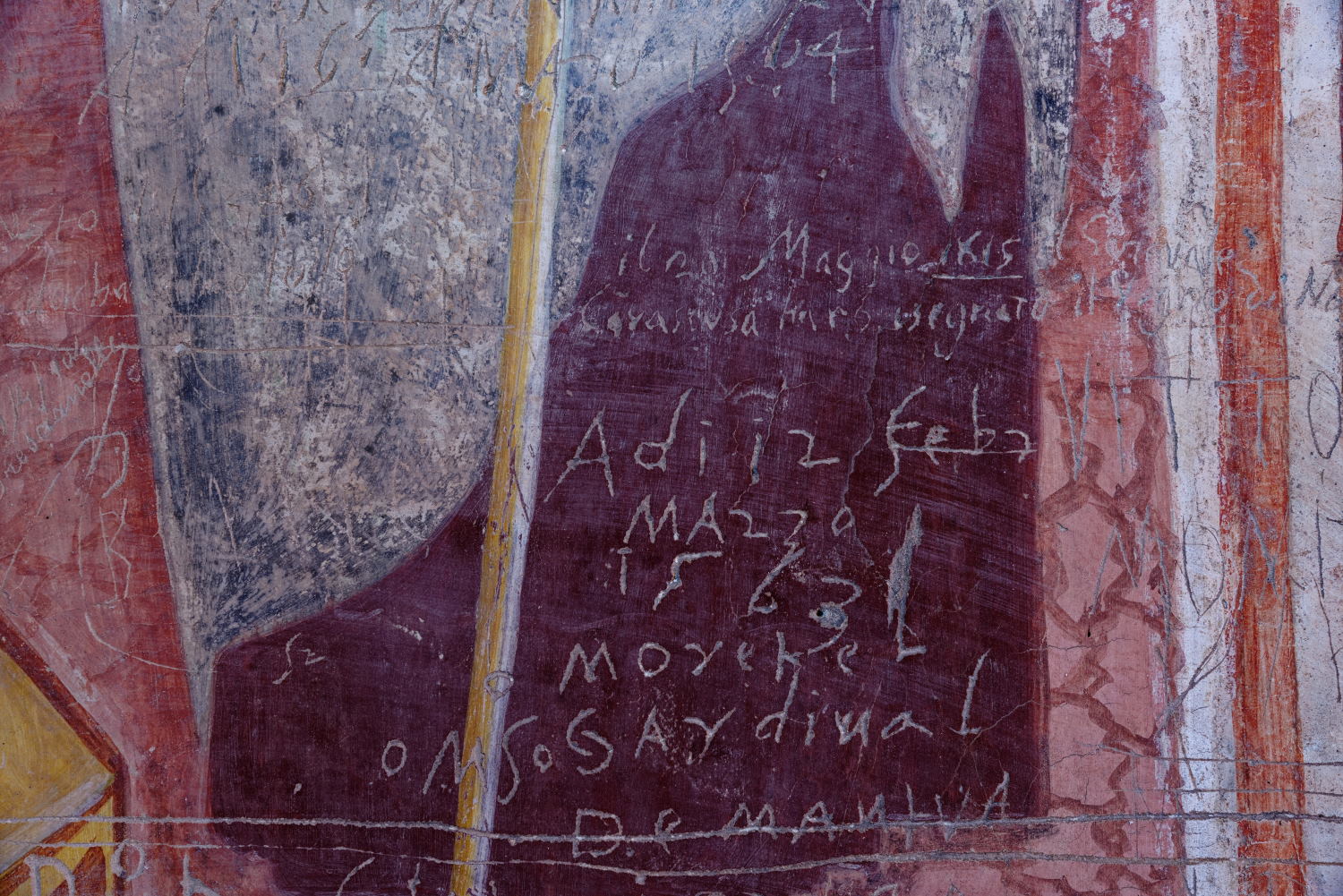
Many of these people, over the centuries, have left traces of their passage via a dense graffiti on the walls, mostly engraved directly on the frescoes.


Romitorio di San Pietro, MN

Romitorio di San Pietro,MN

Romitorio di San Pietro, MN


These are signatures, dates, epigraphs and annotations that provide a valuable historic testimony. We can read inscriptions in German by the Landsknecht troops who would later sack Rome. There are inscriptions by French Napoleonic troops. 


The Corte of Castiglione, on the edge of the village of Casatico is a huge farmhouse complex consisting of a series of courtyards leading to the main house. It has an imposing “star tower” next to the main house. It was built in the fifteenth century by a noble warlord. It was remodelled in the sixteenth and eighteenth centuries. 


Corte di Castiglione,MN

Corte di Castiglione,MN

Corte di Castiglion MN

Corte di Castiglione MN

Corte di Castiglione MN

Corte di Castiglione, MN
The complex is surrounded by a moat which complicated the access to get some interesting photographs of the place. I came home with some rather muddy shoes.


Between the main places I wanted to see I came across the remains of the castles in Redonesco and in Mariana Mantovana.

Castello di Redonesco, MN

Redonesco, MN

Mariana Mantovana, Mn
To end the trip I crossed the river Oglio via a rather precarious steel bridge.

The Oglio, MN

The Oglio, MN

Thursday, February 7, 2019

The Tower of Hunger, Castel d'Ario


Castel d’Ario near Mantua/Mantova is a place I wanted to visit, more for the history rather than any photo opportunities. I tacked it onto the visit to the Po at Revere last week.


This castle has a tremendous history attached to it. A face of early Renaissance Italy that does not rise to the surface often.


Castel d'Ario

Castel,d'Aario
The medieval castle of Castel d'Ario presents itself today as an imposing city wall, about 300 meters long, interspersed by three perimeter towers and a castle gate tower. Today it is mostly a ruin with just one building intact which serves as the town’s library


Castel d'Ario

Castel'Ario
A fifth tower, more massive and elevated, is located inside, inserted in a corner of the enclosure. It is the oldest part of the castle. It is known as the "Torre della Fame" or the “Tower of Hunger”.


Castel d'Ario

Castel d'Ario
During works in the nineteenth century in the cellars of the castle keep, seven skeletons were discovered, one still in chains. Here is the story of how they got there.


Tower, Castel d'Ario

The Dungeons, Castel d'Ario

Castel d'Ario
Francesco I Pico the ruler of Modena after a defeat in battle with an army from Bologna took revenge on the citizens of Modena who he believed had betrayed him. The citizens of the city called in the Rinaldo dei Bonacolsi Duke of Mantova to liberate the city. After a short siege Pico was sent into exile, but five years later in 1321 he returned to the area.


Bonacolsi soon captured him and his two sons who were led naked tied to the back of a mule through a gathering the plebe, who beat them as they passed. Worse was to come.


They were then conducted to the castle of castle D’ario, where they were thrown into the dungeons without food or water and left to die a horrible death.


Bonacolosi in turn was dethroned in 1328 by a coup d’Ă©tat by one of the wealthy families of the city. The Gonzaga’s with the help of troops from Verona took charge of the city after a short bloody battle.

The Duke died of injuries sustained in the battle. Two of Bonacolosi’s sons and two cousins were captured and sent to the dungeons of Caste d’Ario where they too were imprisoned and left to die without food and water. 


Rinaldo dei Bronacolosi was mummified and put on display in the Palazzo Ducale in Mantua.


This castle served as a prison for the Gonzaga’s and other notables were imprisoned here.


Castel d'Ario
Imprisonment went better for Taddea Cardinalina, known as the wife of Cardinalino, or the son of Cardinal Francesco Gonzaga. Her husband found her in bed with her brother Enea Forlani. She was imprisoned in the castle, together with her daughter but not in the infamous tower. After two years she was released.
Castel d'Ario


Castel d'Ario

The Castle is one of the few that was not demolished when the area was ruled by the Austrians.